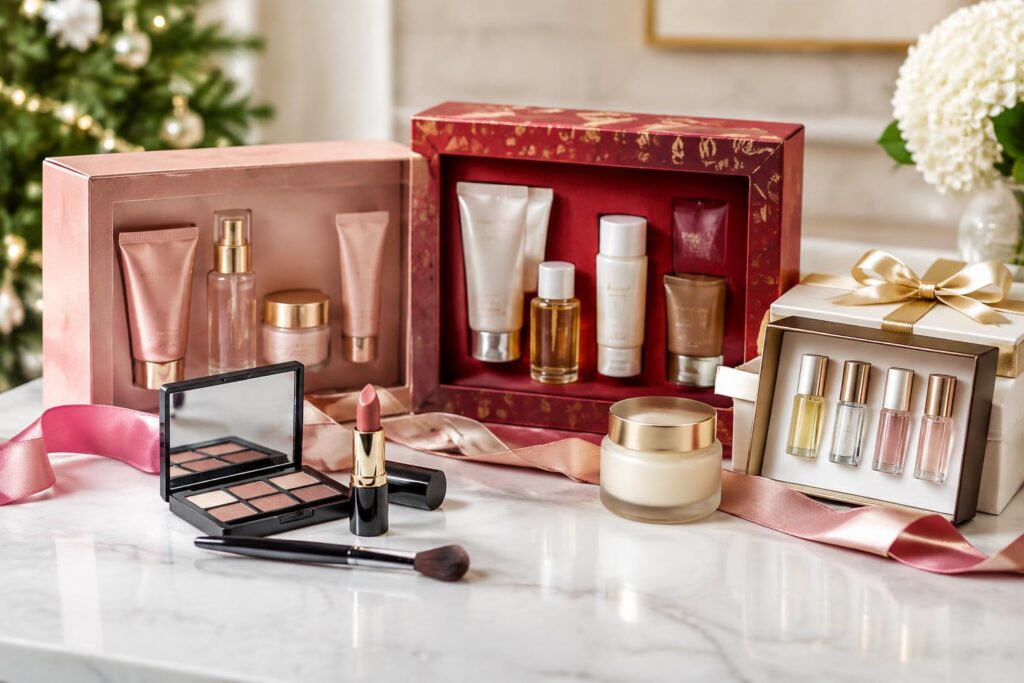
A beauty set’s stated value is not the same as a previous selling price or a guaranteed saving. Start with the exact products and sizes inside, then compare the items you want with their suitable alternatives. A set can be useful for trying several products without being a discount on a full-size routine.
The numbers below are hypothetical. They do not describe a current beauty set, a retailer price history or a claim that different formulas perform alike.
Separate the contents from the value label
List each item, its size and its role: cleanser, moisturizer, fragrance, makeup or accessory. Distinguish a mini from a full-size product using the actual volume or weight, rather than the size of the box or the number of pieces in the headline.
Check whether applicators, pouches or tools count toward the advertised piece total. An empty pouch is a different benefit from another bottle. It may be useful, but it should not be counted as product volume.
Compare volume only where it is meaningful
Imagine two sets of the same fragrance formula and concentration. Set A contains five 10-mL bottles for $25, while Set B contains two 40-mL bottles for $32. If you will use every bottle, the comparison is:
| Hypothetical set | Total fragrance volume | Purchase price | Price per mL |
|---|---|---|---|
| Five 10-mL bottles | 50 mL | $25 | $0.50 |
| Two 40-mL bottles | 80 mL | $32 | $0.40 |
The larger bottles cost less per mL in this example, but require $7 more today. The smaller bottles may suit someone who wants portable portions. Neither result proves that either format is a current bargain.
Do not apply that calculation indiscriminately to a mixed skincare kit or different fragrances. A cleanser and an eye product serve different purposes; adding their volumes does not make one an equivalent substitute for the other. Even similarly named products may have different formulas or concentrations.
Adjust for the products you actually want
If a five-scent sampler contains only two scents you expect to use, its full volume overstates the useful amount for you. In a hypothetical $25 set of five equal 10-mL fragrances, using only two leaves 20 useful mL. The cost per useful mL becomes $1.25.
That does not mean a sampler is always poor value. Trying unfamiliar scents can be the purpose of the purchase. Decide whether you are paying for variety, a gift presentation or a refill of products you already know. Do not assume unwanted pieces have a resale value that offsets your cash payment.
Read “value” and “was” as different claims
A stated value may describe an estimate based on the contents; it does not by itself show that the boxed set previously sold for that amount. A percentage reduction from a claimed value is therefore a different comparison from a documented reduction in the set’s own selling price.
Check what the label says and what the retailer explains about its reference basis. Avoid treating the largest printed number as the amount you personally save, especially when you would not otherwise buy all the contents.
Check the exact set before choosing
- Match every product, scent or shade and its actual size.
- Check whether the set contains duplicates, tools or an empty bag.
- Read ingredients, use instructions and the selected item’s return terms.
- Compare the delivered cost with the products or format you really want.
For the broader bundle decision, see our shopping tools. Keep the set’s practical purpose separate from its stated value so that the purchase fits the recipient or your existing routine.