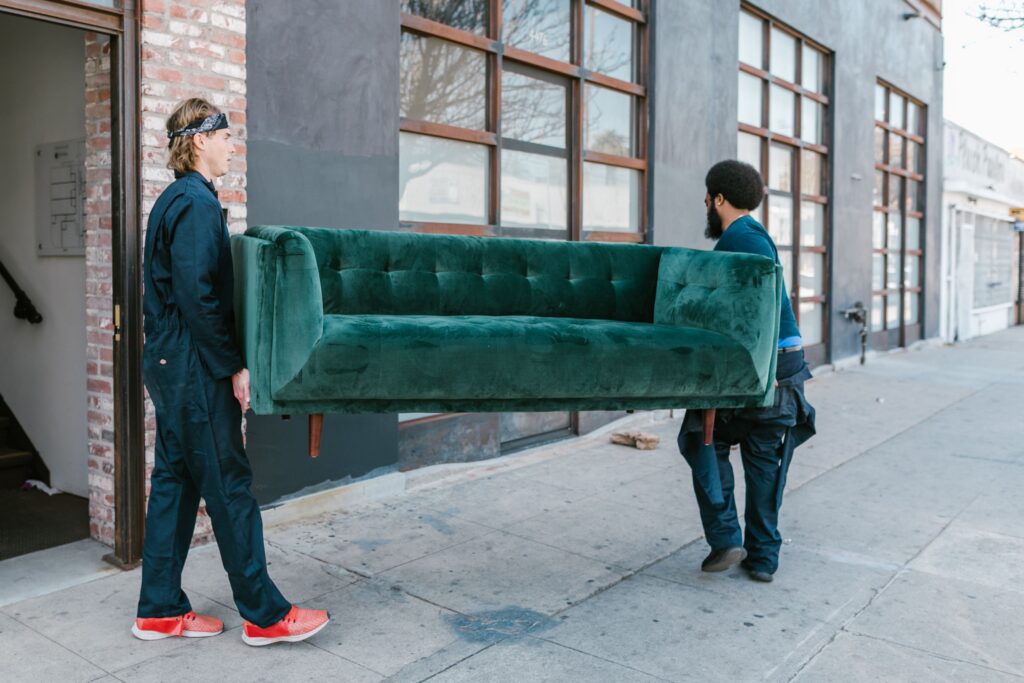
A sofa can fit the space where you want it and still be difficult to deliver there. Before ordering large furniture, compare the item’s delivery configuration with the full route from the drop-off point to its final position. The product’s assembled dimensions are only part of that check.
The goal is to identify missing information while you can still choose another model or delivery arrangement. A rough measurement can flag a problem, but it cannot guarantee that a large piece will pass a turn or staircase.
Find out what actually arrives
Look for carton dimensions, the number of packages and the largest individual component. An assembled sofa, a modular sofa delivered in several sections and a flat-packed sofa create different delivery requirements even if their finished widths are similar.
Ask whether legs, cushions or other components arrive attached and which parts the manufacturer permits to be removed for delivery. Do not assume a back, arm or leg comes off because a similar model has that feature. If the product page gives assembled dimensions only, request its packaged dimensions and delivery guidance before ordering.
| Information to collect | Why it matters |
|---|---|
| Finished dimensions | Checks the furniture’s position and usable space in the room |
| Largest carton or delivery component | Identifies what must travel through the access route |
| Number and weight of packages | Helps assess the delivery arrangement and handling requirements |
| Approved removable parts | Establishes whether the delivery dimensions can legitimately change |
Walk the complete route with a tape measure
Start at the actual delivery entrance, not automatically the front door. Note gates, building entrances, hallways, interior doors, stairs, landings and the final room entrance. If an elevator is involved, check its usable opening and interior space as well as any building delivery restrictions.
Measure clear openings between the obstructions the furniture must pass. A doorway’s advertised door size is not necessarily its available opening when the door, hinges or handle take up space. Record low ceilings, rails, fixed cabinets and other projections. Take photographs or make a simple sketch so a delivery provider can understand the route rather than receiving a list of unexplained widths.
Do not remove doors, railings or fixtures on the assumption that doing so will solve the problem. Establish building permission and the delivery provider’s requirements before planning any such work.
A straight doorway is different from a turn
Imagine a hypothetical carton measuring 78 × 30 × 24 inches and a clear doorway measuring 32 inches across. The carton’s smaller dimensions may make that doorway look promising in isolation. But those figures do not establish whether the carton can turn from a narrow hallway, clear the ceiling or rotate on a stair landing.
A diagonal measurement can be another useful detail, but a diagonal longer than the furniture does not prove that all of its width and depth can pass through the available three-dimensional space. For close fits, give the exact package measurements, photographs and route sketch to the retailer or delivery provider and request a specific assessment.
Compare the service included in the total price
Before comparing delivered prices, establish what each service includes. Curbside drop-off, delivery inside the entrance, placement in a room, assembly and packaging removal are different tasks. Confirm which are included for the exact item and address, and what any additional services cost.
As a hypothetical comparison, a $600 item with $100 delivery and $80 required assembly totals $780. A $750 alternative including the same delivery and assembly would cost less overall. That comparison works only if the included work is actually equivalent; it does not establish either seller’s real charges.
Also check the current terms for an unsuccessful delivery, cancellation, return collection and any assembly-related return restrictions. Use the seller’s actual terms rather than assuming a standard fee or a free return.
Confirm the plan before placing the order
- Save the exact model, delivery configuration and largest package dimensions.
- Check both room fit and the full access route.
- Ask the provider about any close opening, turn, stair or elevator constraint.
- Confirm service level, building arrangements and the full amount due.
- Keep the delivery assessment and relevant order terms with the purchase record.
Use our shopping tools to organize the comparison. A clear delivery plan makes a furniture price more meaningful because it includes getting the right item to the place where you can use it.
Photo: RDNE Stock project on Pexels, used under the Pexels License. The scene illustrates furniture moving; it does not establish whether a particular item will fit your delivery route.