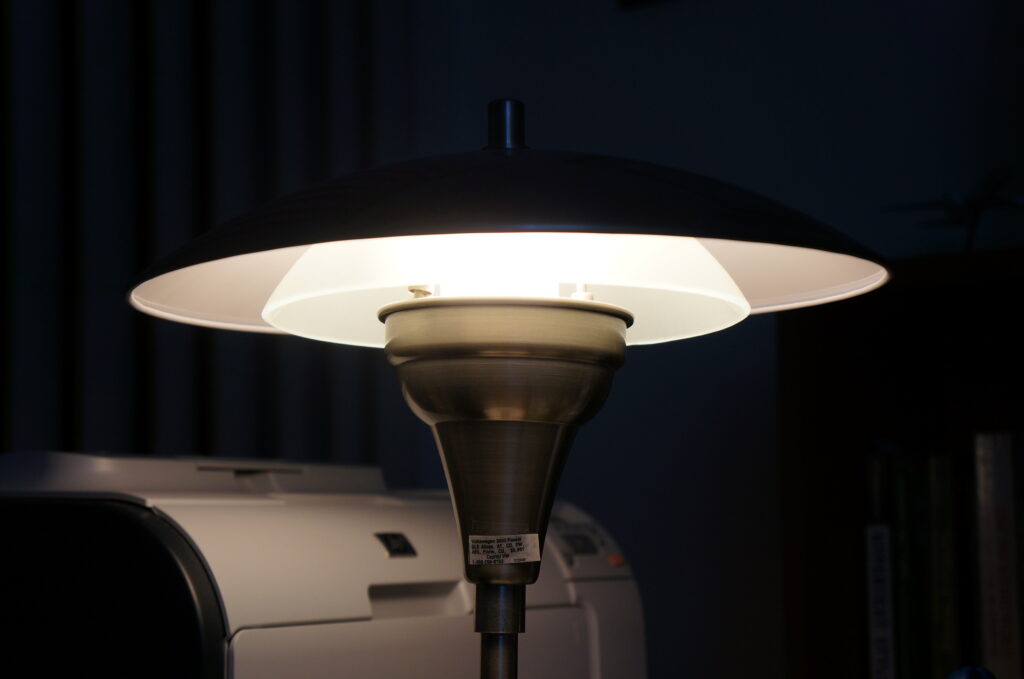
A desk lamp needs to place useful light on the part of the desk you use. Overall height alone does not show whether the shade reaches your notebook, the base crowds your keyboard or the controls are comfortable to adjust while seated.
Mark the work area before comparing lamps
Identify the place where you write, read or assemble small projects. Then measure the space available for a lamp beside it. Include the keyboard, monitor stand and supplies you normally leave out, rather than measuring an empty desk that will not stay empty.
A narrow base can help with a crowded surface, but the head still needs room to move. A clamp design changes the question to desk-edge thickness and access underneath. Do not assume that a lamp described as adjustable includes every kind of arm or mounting adjustment.
Separate brightness controls from color controls
The IKEA KORVSNÖRE LED desk lamp, article 806.243.01 has a dimming knob on its base and an adjustable head. Its specifications list a warm 2700 K color temperature and 170 lumens. Dimming changes light output; those details do not establish an adjustable color-temperature range.
If you want both kinds of adjustment, look for both in the specification list. Compare the controls themselves as well: a rotary knob, button and touch panel each require a different motion and may sit in a different place on the lamp.
Compare the assembled dimensions
KORVSNÖRE is listed as 14 inches high, with a 5-inch base diameter and a 6-foot-7-inch cord. Its packaging dimensions are listed separately. Use assembled measurements for the desk and cord length for planning the route to an appropriate power outlet.
Hypothetical space example: a 5-inch round base fits inside a clear 6-inch square on paper, leaving only half an inch per side when centered. That arithmetic does not show whether the head can point where needed or whether your hand will bump the base while working. Check the whole operating space.
Check the light source and power arrangement
This IKEA model uses a built-in LED light source. Compare that arrangement with a lamp that accepts a replaceable bulb, including what the manufacturer says about servicing or replacement. A stated estimated light-source life is not a promise that every component will last that long.
For any lamp, establish what comes in the box: bulb, power adapter, cable or clamp where applicable. A USB connection does not, by itself, establish that a wall adapter is included. Match the power requirements to the supplied equipment and instructions.
Make the adjustment you will actually use
Think through a normal session: move a notebook into place, point the shade, adjust brightness and reach the switch at the end. A lamp suited to one fixed reading spot may need less movement than one shared between a keyboard and a craft mat.
Choose the smallest set of features that covers that routine, then compare the total purchase cost of any separately required components. For related workspace planning, see our desk and study collection and charging accessory comparisons.
Some shopping links are affiliate links; we may earn a commission from qualifying purchases.
Illustrative desk-lamp photograph by FASTILY, via Wikimedia Commons, CC BY-SA 3.0. Resized for display under the same license. The photograph does not depict KORVSNÖRE.