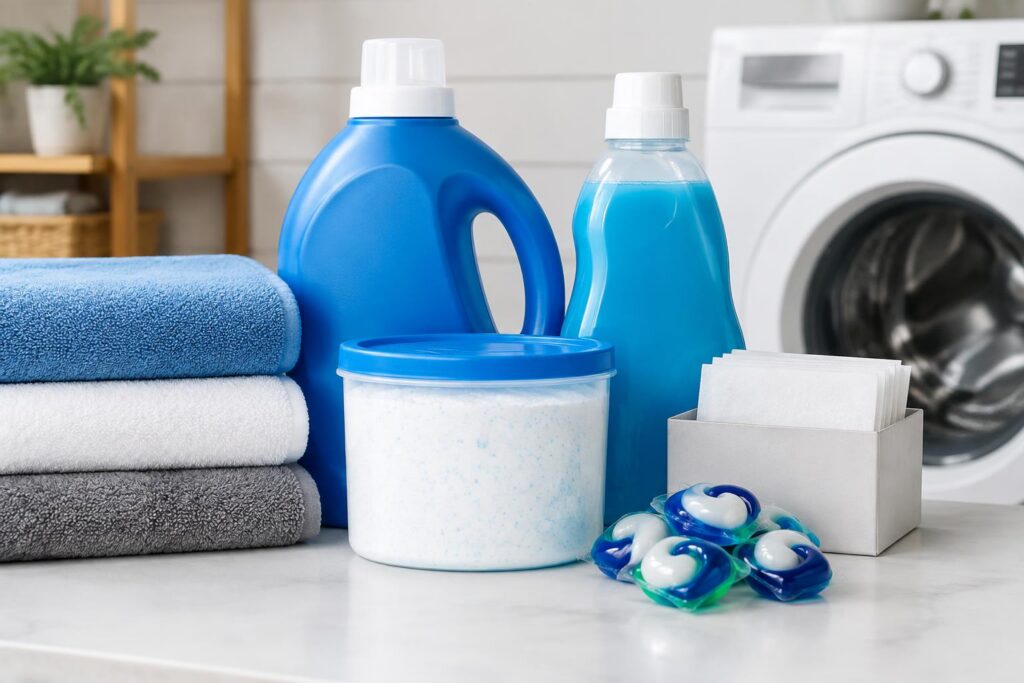
A laundry detergent bottle’s advertised load count is useful only when you understand the dose behind it. Two bottles with different labeled load counts may use different amounts per wash. A larger bottle does not automatically provide more washes under the conditions in your laundry room.
Read the exact product’s directions for the machine, load size and other conditions described on its label. Then compare the amount you expect to use. This guide uses hypothetical quantities and costs to explain the calculation; it does not advertise a current detergent offer.
Find the dose behind the front-label number
Look for the dosage instructions supporting the advertised number of loads. Note which load size and other conditions the product associates with that dose. If the label gives different directions for larger or more soiled loads, keep those separate rather than treating the smallest dose as universal.
For liquids, distinguish the cap’s total capacity from any marked fill lines used in the directions. For powder, check the scoop markings and the label’s measure. For packets, record the number the manufacturer directs you to use for the relevant load. Do not switch a measure between products and assume that it represents the same dose.
| Format | Quantity to compare | Important distinction |
|---|---|---|
| Liquid | Total liquid divided by the applicable labeled dose | Use matching volume units and the exact formula’s directions |
| Powder | Total powder divided by a compatible labeled dose | Do not mix weight and scoop volume without a supported conversion |
| Packets | Total packets divided by packets required per wash | A packet count is not always the same as a wash count |
Calculate the washes relevant to your routine
Suppose a hypothetical liquid bottle contains 90 fluid ounces. At a labeled dose of 1.5 fluid ounces for the conditions described by that hypothetical label, it provides 60 washes: 90 ÷ 1.5 = 60.
If that same hypothetical product’s directions specify 2 fluid ounces for the loads you routinely wash, the bottle provides 45 washes at that dose: 90 ÷ 2 = 45. The bottle has not changed; the relevant dosing assumption has.
These figures are not dosing recommendations for any real product. Follow your detergent’s directions and your machine’s instructions. Do not reduce a recommended amount simply to reproduce a larger advertised wash count.
Compare a bulk purchase at the same dosing basis
Imagine Bottle A costs $12 and supplies 45 washes at the applicable labeled dose. That is about 27 cents per wash. Bottle B costs $15 and supplies 60 comparable washes at its applicable labeled dose: 25 cents per wash. Bottle B costs more upfront but less per wash in this hypothetical comparison.
The comparison requires both products to suit the laundry job. Different formulas, machine compatibility and care requirements can matter more than a small mathematical difference. Do not compare a liquid detergent’s volume directly with a packet count, or assume that every product needs the same dose.
For actual Amazon offers, compare current eligible totals on Amazon with the exact pack and purchase option selected. No current Amazon product prices or unit prices are used in this guide. Our laundry and paper unit-price guide covers the broader household comparison, including paper sheets and area.
Keep detergent separate from laundry additives
A detergent, rinse product, stain pretreatment and scent additive serve different purposes. Their labeled quantities are not interchangeable detergent washes. A bundle can contain several useful products without providing the same number of complete laundry loads from every component.
Likewise, a larger package of an additive does not make a detergent bottle last longer. If comparing a bundle, list each component and its own expected use separately, then decide which products you would actually buy.
Choose the subscription interval from actual use
Once you have a realistic wash count, compare it with how often your household washes laundry. A hypothetical 45-wash supply used for five washes a week lasts about nine weeks. At seven washes a week, the same supply lasts a little over six weeks.
That estimate is a planning aid rather than a promise. Leave room for changes in load size or frequency, and review the next delivery before it processes. A first-delivery promotion does not establish the price of a later shipment.
Our Amazon laundry collection separates the selected packs and claim steps. Use the dose comparison here to judge how those quantities fit your routine, without treating a subscription option or a bulk pack alone as proof of a bargain.
Illustration shows general laundry and paper supplies, not the exact products or hypothetical prices discussed here.