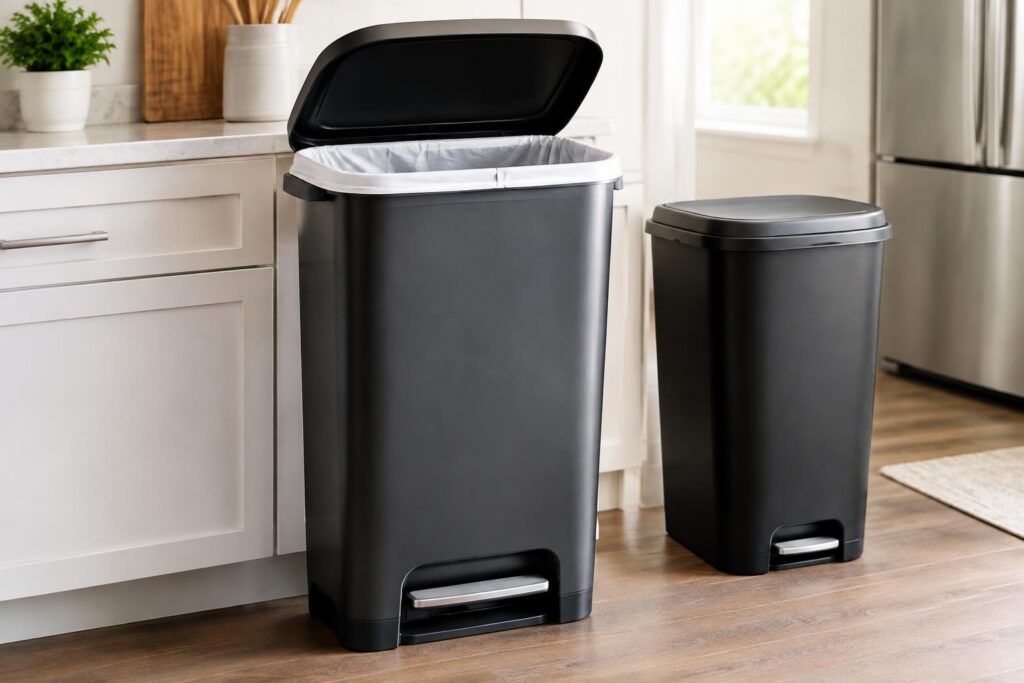
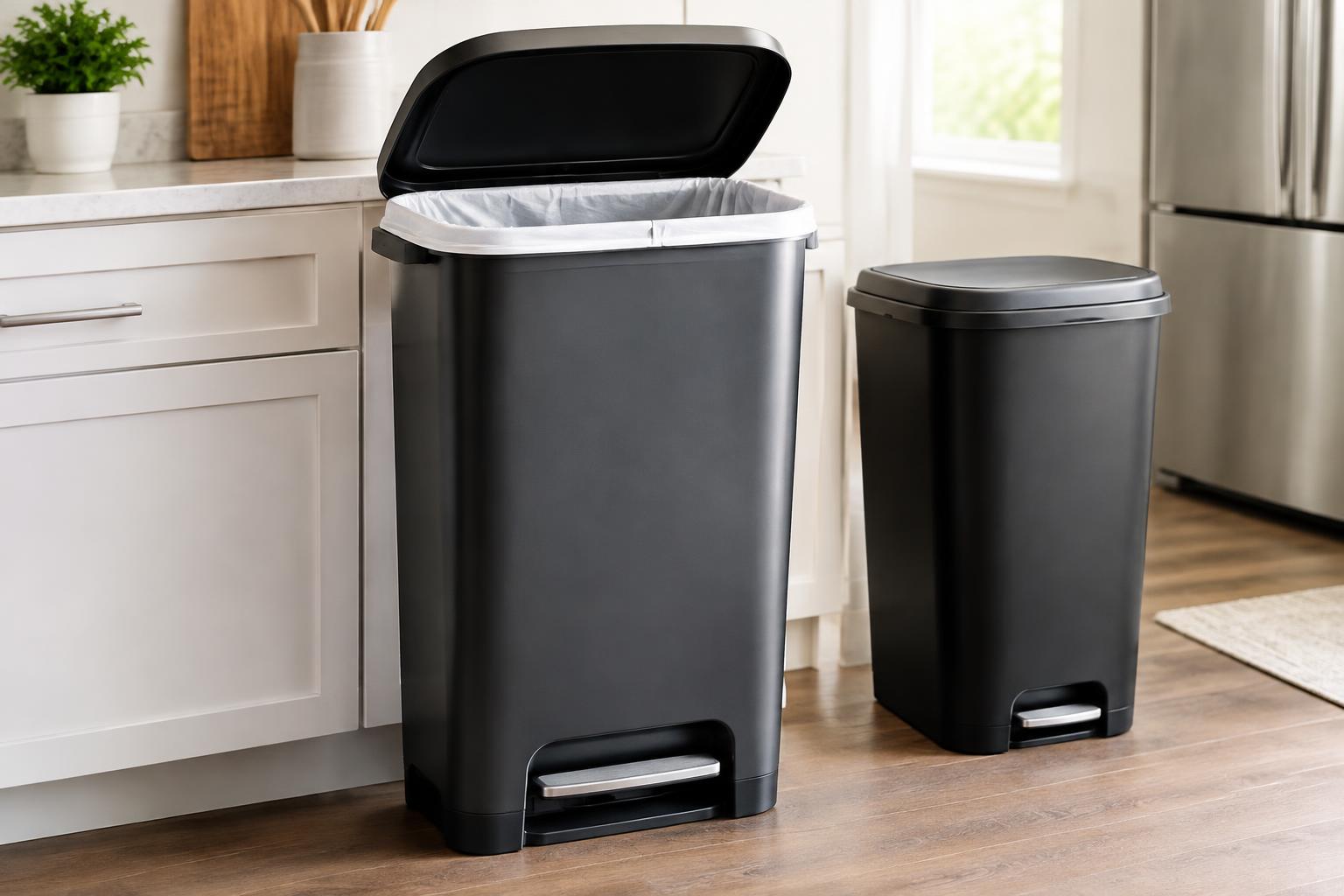
A trash bag needs to pass over the can’s opening, reach the bottom and leave enough material to fold over the rim and close. The gallon number is a useful starting category, but compare the bag’s actual dimensions and closure with your can before committing to a large pack.
This buying guide focuses on fit and usable quantity. It does not claim a current discount or assume that a bulk pack is the cheapest option for every household.
Write down the can measurements first
Measure the opening at the widest points and the inside height. Note a rim, retaining ring or removable inner bucket that changes how a liner is installed. If the can maker specifies a liner code, start with that exact model’s instructions and compare any alternative with the recommended liner.
For a rectangular opening, record both width and depth. For a round opening, record the diameter or measure around the rim. Keep the units consistent with the bag listing; do not compare inches with centimeters without converting them.
| Check | Why it matters |
|---|---|
| Opening shape and width | The liner has to go over the rim, not just occupy the can’s volume |
| Inside height | A short liner may hang from the rim instead of resting at the bottom |
| Fold-over and closing space | Part of the bag is used outside the can and for tying it closed |
| Retaining ring or liner code | A model-specific fitting system may need a particular size or installation method |
Use a perimeter check without treating it as a fit guarantee
Hypothetical geometry example: a rectangular opening measuring 12 by 9 inches has a perimeter of 42 inches: 2 × (12 + 9). A simple flat, ungusseted bag with a 21-inch opening width has a 42-inch opening circumference before allowance. That would only match the theoretical perimeter; it leaves no extra room to pull over a lip or install comfortably.
This is a comparison aid, not a universal sizing formula. Gussets, stretch construction, drawstrings and the manufacturer’s measurement method change how dimensions should be read. Use the expanded or finished dimensions provided for the actual bag and the can maker’s guidance.
Check length and closure together
A bag’s length has to accommodate the can’s shape as well as its height. Leave enough material for the bottom to settle and the top to fold and close. Do not assume that a wide enough bag is also long enough.
A drawstring, quick-tie flap and twist-tie design use different closing arrangements. Choose the style you prefer, then check fit within that style instead of assuming every pack with the same gallon label has the same dimensions. Glad’s kitchen bag range and small and medium bag range provide separate size and closure choices to compare.
Count bags you will actually use
For a household with several bins, list the kitchen, bathroom and office needs separately. A liner that is oversized for one small bin may waste material, while a small liner can be unusable in the main kitchen can. A mixed household does not automatically need the same bag in every room.
If trying a new fit, a small pack can be a useful first purchase before a large restock. Once the fit works, record the exact size, closure and product description so the next bulk comparison uses the same kind of bag.
Compare the full pack accurately
Record bags per box, boxes per order and any differences between variants. “Three packs” does not establish the total number of liners until you know the count in each pack. Compare price per usable bag only from current, comparable inputs, with shipping and any purchase conditions kept separate.
Use the shopping tools for a current purchase calculation, and the Amazon deals hub when browsing a restock. A large pack earns its place when it fits the can and matches your use, rather than from the pack count alone.